🌿 WHAT WE’LL EXPLORE TOGETHER 🌿
1. Guarding the Word: A Covenant Command
2. The Language of Creation
3. Confusion at Babel — When Language Broke
4. The Name Spoken From Heaven
5. New or Renewed? Understanding Revelation 3:12
6. Transliteration vs. Translation — What Really Happened to the Name?
7. Prophets, Shadows & The Branch — The Name Written Before Bethlehem
8. The Name Revealed — Yahusha in the Language of Creation
9. When Empires Conquer, They Rename
10. Suffering for the Name — Why the Early Believers Paid a Price
11. Selah — Pause, Reflect, Return to the Ancient Path
Guarding the Word: A Covenant Command
Do not add to it. Do not take from it
Before we talk about any name, Scripture forces us to deal with one truth first:
Yahuah warned His people — from beginning to end — not to alter His Word.
Deuteronomy 4:2 opens with a command:
Do not add to it. Do not take from it.
Revelation 22:18–19 closes with the same warning.
Between those two bookends sits the entire covenant story — protected, preserved, and safeguarded.
Names, commands, prophecies, identities — all of it mattered enough to be guarded.
Names in Scripture are not decoration.
They are declarations.
They reveal identity, assignment, origin, and destiny.
So if Yahuah guards every word… what does it mean when a name is changed?
Have we preserved what He wrote?
Or inherited something rewritten by others?
That question becomes the thread that guides this entire study.
The Language of Creation and Why Hebrew Still Matters
Because identity begins with the language Yahuah used to speak creation into existence.
Before Babel, before nations, before confusion, there was one pure tongue — the language Yahuah Himself used to speak creation into existence. That matters. Because creation responds to the voice of its Creator.
According to the book of Jubilees, this “language of creation” was restored to Abram as a covenant gift.
Not just a tongue — a vessel of truth.
Not just speech — alignment.
This is where the story of names begins.
The language Yahuah chose for His covenant people was not selected by culture, geography, or kingdom influence. It was chosen because this language could carry meaning without distortion.
When Babel scattered the nations and confused their tongues, the language of creation went into hiding — preserved only through a remnant line until the covenant passed to Abraham.
Why does this matter?
Because the language Yahuah used to speak creation…
is the same language He used when He revealed the most important names in Scripture.
Names were never meant to begin in Greek, Latin, English, or Roman tradition.
They were spoken from heaven in the language of creation — then passed down through prophets, priests, and scrolls.
So if the language shifted…
the question becomes:
What else shifted with it?
When Yahuah Confused the Nations at Babel
Where meaning fractured, and the world’s languages began shifting beneath our feet.
Genesis 11 describes the moment everything changed.
No war. No famine. No exile.
Just one act: Yahuah confused their language.
Why?
Not because He despised unity — but because humanity was building without Him.
They were united in rebellion, aligned in pride, determined to reach heaven on their terms.
So He broke their language.
People could no longer understand one another.
Communication fractured.
Meaning shifted.
Words lost their original power.

From that moment on, human language became unstable ground — constantly changing, constantly bending to culture, conquest, and empire.
This is where the first “rewriting” begins.
Because if the enemy cannot destroy truth, he will distort it.
If he cannot erase a name, he will rename it.
After Babel, the nations scattered — and so did their tongues.
But through Abraham, Yahuah preserved the one language that carried the meaning He intended.
The question becomes:
If the language changed for the nations…
did the nations eventually change His names?
The Name Spoken From Heaven in the Hebrew Language of Creation
The Messiah’s voice revealed the language that carries His identity untouched.
Acts 26 gives us one of the most overlooked details in the entire New Testament:
When the risen Messiah spoke from heaven, appearing to Sha’ul on the Damascus road…
He did not speak Latin.
He did not speak Greek.
He did not speak English.
He spoke in the Hebrew tongue.
The same language given to Abraham.
The same language preserved through the prophets.
The same language used to record divine visions.
The same language of creation.
This detail matters — deeply.
Because it means the name spoken from heaven did not originate in Rome.
It did not originate in Greece.
It did not originate in Europe.
It originated from the mouth of the Messiah Himself — in Hebrew.
If the name was spoken from heaven in the language of creation…
why does the whole world now use a different one?
If the apostles suffered for a name the world no longer speaks…
what name were they defending?
If there is “no other name under heaven by which we must be saved”…
how did we end up with a name that didn’t exist until centuries later?
These questions are not accusations.
They are invitations.
Because Scripture is whispering a mystery we were never taught to ask.
A New or Renewed Name? Understanding What Yahuah Promised
The Hebrew word behind “new” leads us back to what was restored, not replaced.
Before we talk about the Messiah’s name, we must deal with a verse most people misunderstand — a verse that quietly exposes how much has shifted over time.
Revelation 3:12 says the Messiah will have a “new name.”
For most people, the English word “new” sounds like something different — something that replaces what came before.
But the Hebrew word behind “new” is deeper:
It means restored.
Renewed.
Returned to original strength.
Brought back to what it used to be.
Just like David prayed:
“Renew a right spirit within me.”
Just like the prophets spoke:
“Renew the ruined cities.”
Renewal is not replacement.
It is restoration.
So when Revelation says the Messiah’s name will be “new,” it is not telling us that heaven invented a different name after He ascended.
It is saying His original name — the one spoken in the language of creation — will be restored to His people in the end.
Not a new identity.
A recovered one.
If Revelation says the name will be restored…
what name did we lose?
Translation vs. Transliteration: How the True Name Changed
Because meanings translate—but names carry identity sound for sound.
Before we reveal the Name itself, we must understand the method.
A name should never be translated.
Meanings get translated — names get transliterated.
If my name is Tiffany, you might say it with an accent — but you do not change it to fit your language.
If Vladimir Putin goes on international news, every nation keeps his name.
When world leaders speak about Xi Jinping, no country translates his name into their language.
Because a name is an identity — not a vocabulary word.
Scripture should follow this rule.
Names carry identity — and they must remain intact.
If the Father spoke a name in Hebrew, it is not our place to alter it to fit another culture.
Our task is to carry it — sound for sound — into the next language.
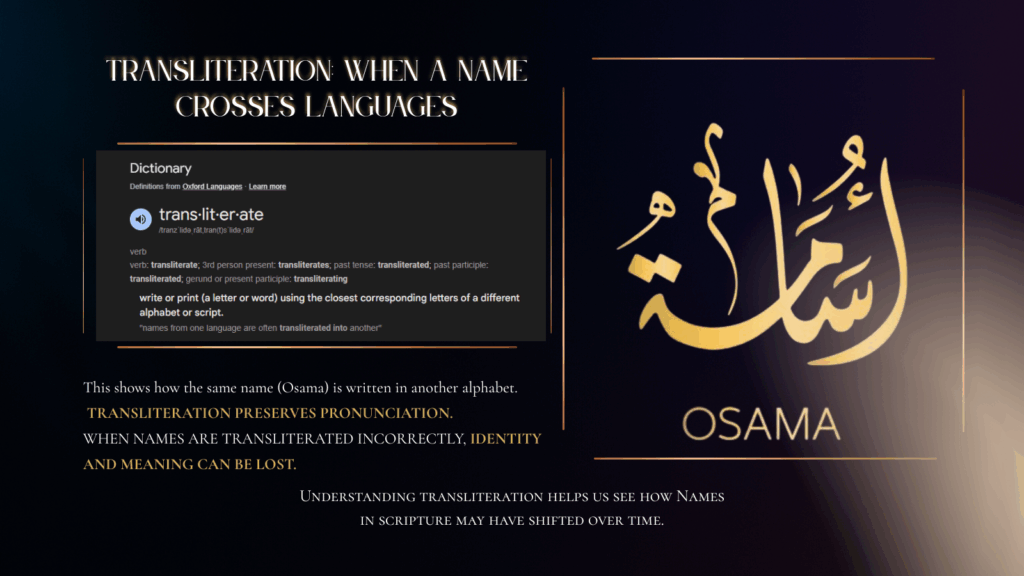
Transliteration is simple:
Move the sound of the name into the nearest letters of the next language.
To make this plain, here’s a simple example of transliteration using a modern name. Notice how the sound stays the same, even when the alphabet changes. Names carry identity, not translation.
Translation is something else entirely.
It creates a new word with a new meaning..
Names travel globally without translation because identity is tied to sound.
But when the Messiah’s Name crossed languages, something different happened.
Instead of traveling directly from Hebrew to English — which would have preserved both the sound and the meaning — it passed through Greek and Latin, languages that could not reproduce key Hebrew sounds:
No “Y”
No “sh”
No “u”
No “ah” ending
No connection to the Father’s Name
So the Name changed — not once, but in stages.
And by the time it reached English, the world embraced a form that never appeared in any Hebrew manuscript, scroll, prophecy, or first-century tongue.
This wasn’t just a linguistic gap.
This was a process — and processes, even innocent ones, can still create distance from truth.
And here is the part we rarely question:
How many times have you read your Bible and stumbled over the names of ordinary people —
Zephaniah, Zedekiah, Jehoshaphat, Nehemiah —
mumbling through the syllables because those names were preserved exactly as they were written?
We laugh about it in Bible study.
Everyone fumbles.
Everyone slows down.
Everyone does their best to pronounce names that were properly transliterated from Hebrew into English.
But the most important Name in Scripture…
the Name with prophecy attached…
the Name the apostles suffered for…
the Name heaven spoke in Hebrew…
did NOT receive the same treatment.
The Father warned us:
Do not add.
Do not subtract.
Do not change the Word — names included.
So the question becomes:
If regular human names were preserved with care…
why was the most important Name in all of Scripture changed?
The Prophets Foretold the True Name in Hebrew
Long before Bethlehem, the prophets preserved His identity in the language of creation.
Long before the Messiah was born in Bethlehem, the prophets were already writing His name — in Hebrew.
Not a title.
Not a symbol.
The true Name spoken in heaven.
Even the book of Daniel confirms this pattern. Parts of Daniel were written in Hebrew and parts in Aramaic — and the distinction is intentional. Whenever Daniel records what Yahuah revealed, the scrolls use Hebrew, the language of identity, covenant, and prophecy. But when the scene shifts to conversations with kings or the affairs of empire, the scrolls switch to Aramaic, the language of the nations. Scripture itself shows that heavenly revelation was preserved in Hebrew, while human dialogue was recorded in another tongue. His Name belongs to the language of revelation — not the languages of empire.
To understand that, we must understand one of the clearest prophetic shadows in Scripture:
Zechariah 6 — The Prophetic Blueprint
In Zechariah chapter 6, Yahuah instructs the prophet to do something unusual:
- Take silver and gold.
- Make a crown.
- Place it on the head of the high priest.
This was not normal.
Priests did not wear crowns — kings did.
So what is happening?
Zechariah performs a prophetic demonstration:
a priest crowned like a king — a picture of the coming Messiah, who would be both High Priest and King.
Then Zechariah declares:
“Behold the man whose name is The Branch…”
This is where the revelation unfolds.
The high priest who receives the crown already has a Hebrew name written in the scrolls — Yahusha.
Zechariah is not choosing a random priest.
He is crowning a man whose Hebrew name foreshadows the Messiah’s name.
The prophecy is not subtle.
The hint is not hidden.
The name is sitting in plain sight.
- The crowned priest is Yahusha, son of Yahutsadak.
- The coming Messiah — “The Branch” — would carry that same name.
- Scripture even says His name is “The Branch,” pointing toward the Messiah’s identity and mission.
This name is not Greek.
Not Latin.
Not English.
It is Hebrew — preserved in the language of creation.
Jeremiah and Isaiah Confirm the Same Branch

Jeremiah 23:5–6 prophesies a righteous Branch from David’s line — a king whose very name reveals righteousness.
Isaiah 11 describes this same Branch, marked by the Spirit of Yahuah:
- wisdom
- understanding
- counsel
- might
- knowledge
- reverence
This is not coincidence.
This is continuity — a prophetic trail pointing to the same figure with the same Hebrew identity.
The Name Was Already Known in Israelite History
Miriam and Yoseph did not need a theology class to understand the name the messenger gave them.
They were Hebrews.
They knew their history.
They knew their language.
They knew their lineage.
When the messenger said:
“You shall call His name…”
They immediately recognized:
- Yahusha, son of Nun — the deliverer who led Yashara’al into the Promised Land.
- Yahusha, son of Yahutsadak — the priestly figure crowned in Zechariah’s prophecy.
- Yahusha meaning “Yah is salvation.”
They understood the assignment instantly because the name carried history, meaning, and prophetic identity embedded inside it.
This was not a new name.
It was a restored name — a name that had always belonged to Yahuah’s deliverers.
Prophecy, Language, Mission — Aligned
The prophets consistently testify:
- The Messiah’s identity
- His mission
- His name
were already established in the Hebrew tongue long before He walked the earth.
The name was known.
The name was spoken.
The name was written in the prophets’ scrolls.
And when the messenger appeared to Miriam and Yoseph, he didn’t offer suggestions or cultural adaptations.
He said:
“You shall call His name…”
A specific name.
A prophetic name.
A Hebrew name.
The name that matched:
- the language of creation,
- the words of Zechariah,
- the promise to David,
- the legacy of Joshua the son of Nun,
- the priesthood of Yahusha son of Yahutsadak,
- and the mission of salvation itself.
- All in His Father’s Name, Yah!
The name was never meant to shift with culture.
Never meant to be reinvented by empire.
Never meant to be replaced.**
It was meant to be recognized.
Why Yahusha Was Rejected and Another Name Was Accepted
The world resisted the Hebrew Name that carried power, purpose, and prophecy.
Once we understand transliteration, history, and the Hebrew foundation, one question rises above all the others — unavoidable, undeniable, and central to the entire New Testament:
What Name caused the apostles to be beaten, imprisoned, threatened, and commanded to stop speaking?
Acts does not leave us guessing.
It was not a name the world loved.
It was not a name that blended into Roman religion.
It was not a name invented centuries later.
And it was not a name beginning with a letter that didn’t exist until the 1500s.
They suffered for the Name of Yahusha — the Hebrew Name spoken from heaven.
Acts records rulers saying:
“Speak no more in this Name.”
Sha’ul is told:
“I will show him how much he must suffer for My Name’s sake.”
The early assembly rejoiced:
“They were counted worthy to suffer shame for His Name.”
Revelation draws the same line at the end of the age:
- Those who deny His Name align with the beast.
- Those who keep His Name endure to the end.
This part stuns many believers because it’s hiding in plain sight:
The apostles were not persecuted for preaching a message.
They were persecuted for proclaiming a Name.
Authorities never said:
“Don’t preach kindness.”
“Don’t talk about resurrection.”
“Stop believing.”
Their command was very specific:
“Do not speak in this Name.”
Why?
Because kingdoms fall when the true Name is lifted.
Because strongholds break when the true Name is spoken.
Because identity, authority, and deliverance are carried in the Name — not merely in the message.
And here is the tension:
People today do not suffer for using the name “Jesus.”
That name is accepted.
Embraced.
Safe.
Even loved across religions and cultures.
But speak the Hebrew Name the apostles risked their lives to defend…
and suddenly it becomes controversial.
Why?
Because human systems cannot control a Name that Yahuah Himself preserved.
A Name rooted in prophecy.
A Name spoken from heaven in Hebrew.
A Name that carries the Father’s identity inside it.
A Name that has never belonged to empire.
The battle over the Name is not new.
It is ancient.
And it has always been spiritual.
How Empires Renamed Yahuah’s People and Rewrote Identities
History shifted when rulers rewrote names—and with them, a people’s destiny.
All throughout Scripture — and all throughout history — one pattern stays the same:
When empires conquer a people, they rename them.
When nations dominate, they rewrite identity.
When rulers want control, they change what a people are called.
Why?
Because the victors write history,
and when you rename someone,
you reshape how future generations remember them.
Renaming becomes a tool of power — a way to redefine a people’s identity, loyalty, and legacy.
Joseph
Pharaoh renamed Joseph Zaphenath-Paneah — an Egyptian title meant to pull him into Egypt’s system and detach him from his Hebrew identity.
Daniel
Daniel became Belteshazzar, a name invoking a Babylonian deity — an attempt to align him with Babylon’s worship and kingdom.
Hananyah, Misha’el, and Azaryah
Their Hebrew names honored Yahuah…
but Babylon renamed them Shadrach, Meshach, and Abednego, each one dedicated to Babylonian mighty ones.
The Pattern Is Clear
Renaming is not cosmetic.
It is strategic.

- It rewrites origin.
- It shifts allegiance.
- It alters how the world sees you — and how you see yourself.
And once the conqueror’s version is written, taught, and repeated…
the new name becomes “history,” even if it was never the truth.
So if earthly kingdoms renamed Joseph, Daniel, and the sons of Judah…
is it any surprise that the Messiah’s name was targeted the same way?
Name Changes in Scripture: A Pattern of Conquest
| Original Name | Meaning (Hebrew) | Renamed By | New Name | Meaning / Purpose |
|---|---|---|---|---|
| Yoseph (Joseph) | “Yahuah adds” | Pharaoh | Zaphenath-Paneah | Egyptian assimilation |
| Daniy’el (Daniel) | “My Alahym is Judge” | Nebuchadnezzar | Belteshazzar | Honors Babylonian deity Bel |
| Hananyah | “Yahuah has been gracious” | Babylon | Shadrach | Invokes Babylonian deity Aku |
| Misha’el | “Who is like Alahym?” | Babylon | Meshach | Babylonian pagan root |
| Azaryah | “Yahuah has helped” | Babylon | Abed-Nego | Servant of Nebo (pagan deity) |
Note:
Translators could have transliterated the Messiah’s Name directly from Hebrew to English — the same way we preserve modern names — but instead it passed through Greek and Latin first, causing both the meaning and the Father’s Name to be lost in the process.
The Messiah’s Name Through History
| Stage | Language | Form of the Name | Notes |
|---|---|---|---|
| 1 | Hebrew | Yahusha | Contains “Yah” + “salvation” (“sha”) |
| 2 | Greek | Iēsous | Greek lacks “Y,” “sh,” and final “ah” |
| 3 | Latin | Iesus | Meaning not preserved |
| 4 | Early English | Iesus → Jesus | “J” created in 1500s; pronunciation changes |
| 5 | Modern English | Jesus | No “Yah” or Hebrew meaning |
Note:
This was not a transliteration — it was a linguistic chain reaction.
The reason the Messiah’s name became “Jesus” is simple: people kept translating it through the wrong languages. His name started in Hebrew, but instead of going straight from Hebrew → English, as it should have, it went Hebrew → Greek → Latin → English. Every time it passed through another language, pieces of the name were lost because Greek and Latin do not have the same sounds Hebrew does.
English actually does have every sound needed to say His real name correctly, so if translators had gone straight from Hebrew to English, His name would still be Yahusha today. The only reason we have “Jesus” is because we are using a translation of a translation of a translation, not a true Hebrew-to-English transliteration.
A name meant to be preserved was instead altered step by step, until the world embraced a version disconnected from the original Hebrew identity, purpose, and prophecy.
The Remnant Guarding Yahuah’s Name Until the End
Those who refuse to deny His Name become the witnesses of the final days.
Revelation reveals a remnant — small, faithful, uncompromised — who do not deny His Name.
They are not praised for power, influence, or perfection.
They are praised for faithfulness:
You guarded My Word.
You did not deny My Name.
The final conflict in Revelation centers around three things:
The beast blasphemes His Name.
The world follows a different name.
The remnant bears His Name on their forehead.
Names are not small things.
They are spiritual marks.
When the 144,000 stand on Mount Zion, they are sealed with one thing:
The Name of the Father — the same Name carried in the Son.
This is why restoring His Name is not a trend, movement, or branding choice.
It is a return to covenant identity.
Not everyone will receive it.
Not everyone will understand it.
Not everyone will want it.
But for those who feel the pull — the conviction, the stirring, the awakening — the Name becomes more than letters.
It becomes recognition.

What if returning to the Name is part of returning to the covenant itself?
Selah: Returning to the Language of Creation and the Name Above All Names
Before Yashara’al entered the land, before kings rose, before prophets cried out, Yahuah gave one instruction to the priests:
Place My Name upon My people.
This was not poetic.
It was literal.
His Name was meant to rest on them.
Mark them.
Identify them.
Cover them.
When the world changed that Name, something precious was forgotten.
But when we return to it — not culturally, not rebelliously, not arrogantly — but humbly…
We return to something ancient.
Something tender.
Something prophetic.
This is why the blessing closes with these words:
Thus they shall put My Name on the children of Yashara’al, and I Myself shall bless them.
Not a title.
Not a nickname.
Not an inherited tradition.
🕊 Salt & Light: The Awakening Series — Part 3 of 3
✦ CONTINUE THE STUDY INSIDE THE COLLECTIVE ✦
Missed the live Bible study? You can still walk through this full Awakening series inside the
Salt & Light Collective — complete with replay access, slides, and community reflections.
Go deeper with others who are guarding the Name and walking the ancient path together.
*Available exclusively to Salt & Light members.*
Selah — May His Name be upon you again.
STAY SALTY. BE LIT.
Join the conversation → Salt & Light Collective Bible Study every Sunday at 7 PM ET.
Catch up on past reflections, share your thoughts below, and browse The Scrolls to read other studies.
Then keep walking with us during the week on our podcast,
Salt & Light Confessions — stories, scripture, and set-apart living for today.
Start with the trailer and walk with us as new confessions unfold.
A modern voice on the ancient way.
— Tai ~ Baht-Yah, Daughter of Yah
Comments
BE THE FIRST TO WRITE A COMMENT