🌿 WHAT WE’LL EXPLORE TOGETHER 🌿
1. The Power of His Name
2. The Substitution of “Lord”
3. Why Yahuah’s True Name Still Matters
4. Prophecy: The Renewed Name
Why Yahuah’s Name Still Matters Today
The Power of His Name
REASON 1 — IDENTITY: THE POWER OF THE NAME
There’s power in a name — and there’s unmatched power in Yahuah’s Name today. Out of the Gray was written to uncover why Yahuah’s Name still matters today.
When did we become comfortable calling the Most High by a title He never gave Himself?
If names hold power, what happens when we trade His for a man-made label?
This isn’t just semantics. It’s prophecy fulfilled.
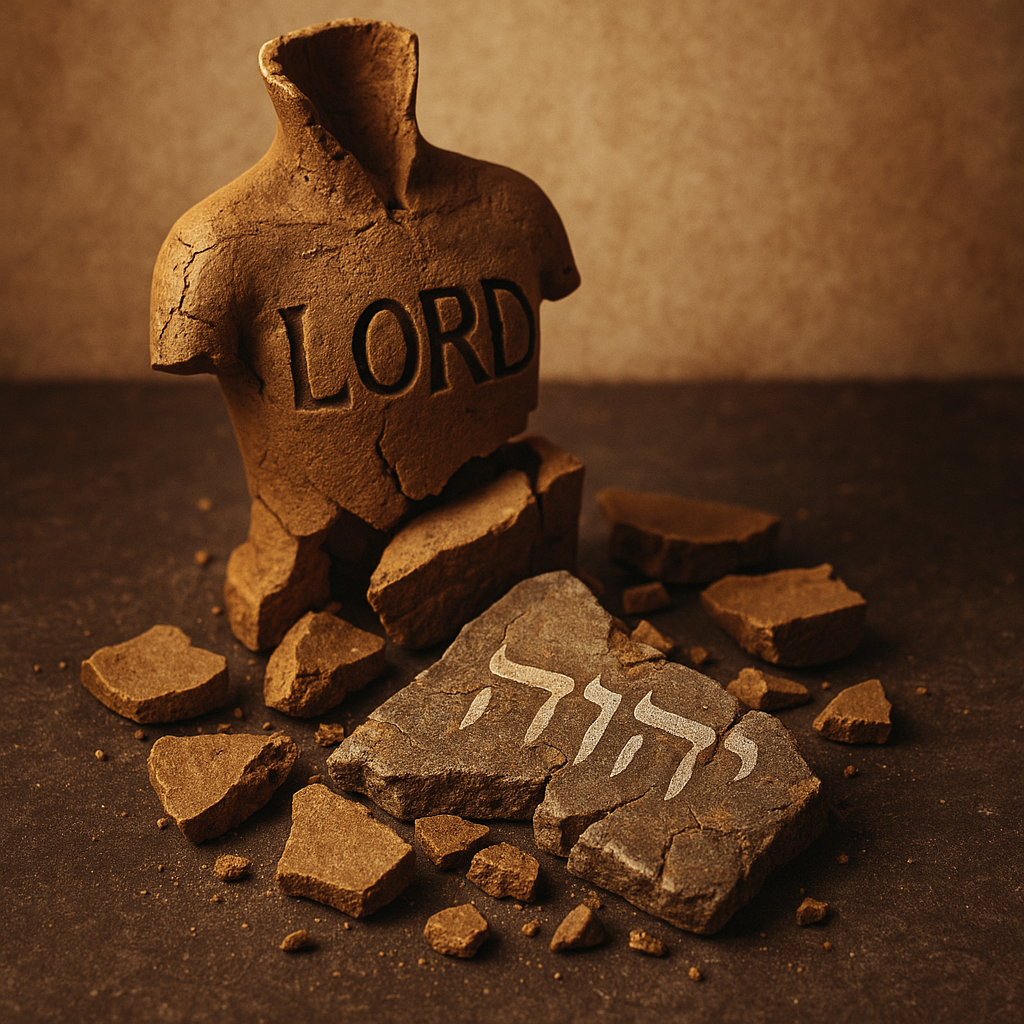
In the preface of most English Bibles, translators confess that,
“In Regard To The Divine Name YHWH, We Adopted The Device Of Rendering It As LORD
(In Capital Letters) To Distinguish It From Adonai.”
A device — meaning a deliberate tool, used for a particular purpose.
They didn’t misplace His Name; they removed it. Nearly 7,000 times.
Exodus 3:15 — “This is My Name forever, and this is My remembrance to all generations.”
Isaiah 42:8 — “I am Yahuah; that is My Name. My esteem I do not give to another.”
Abba’s Name wasn’t erased by accident. It was exchanged — and that exchange was foretold.

Jeremiah 23 : 27 warns that false prophets would cause the people “to forget My Name for Baal.”
And here’s what many still miss: Baal in Hebrew literally means “lord.”
So when we replaced His Name with Lord, we stepped straight into the prophecy Jeremiah saw — calling on a false deity found all through Scripture.
Exodus 23:13 tells us plainly:
“Make no mention of the names of other mighty ones, neither let them be heard out of your mouth.”
Yet modern translations do it thousands of times.
The weight of that command is easy to skim past, but it isn’t just an instruction for ancient Israel — it’s a living reminder for us.
Every time His Name is exchanged for a title, we echo the same mistake our ancestors made in Jeremiah’s day.
It doesn’t always look like open rebellion; sometimes it looks like comfort, routine, and inherited language.
We say what we were taught, not realizing that the very tradition we defend was once a substitution.
Abba’s words in Exodus 23:13 weren’t about superstition — they were about covenant loyalty.
To speak the names of other mighty ones is to mix the clean with the unclean, the true with the false.
When we accepted LORD in place of Yahuah, we didn’t just translate — we traded identity for convenience.
“Rebellion doesn’t always shout.
Sometimes it whispers.”
So how did this happen? How did something so sacred become so easily replaced?
That’s where translation met transliteration — and history quietly shifted.
Translation vs. Transliteration — Why It Matters
Translation changes meaning.
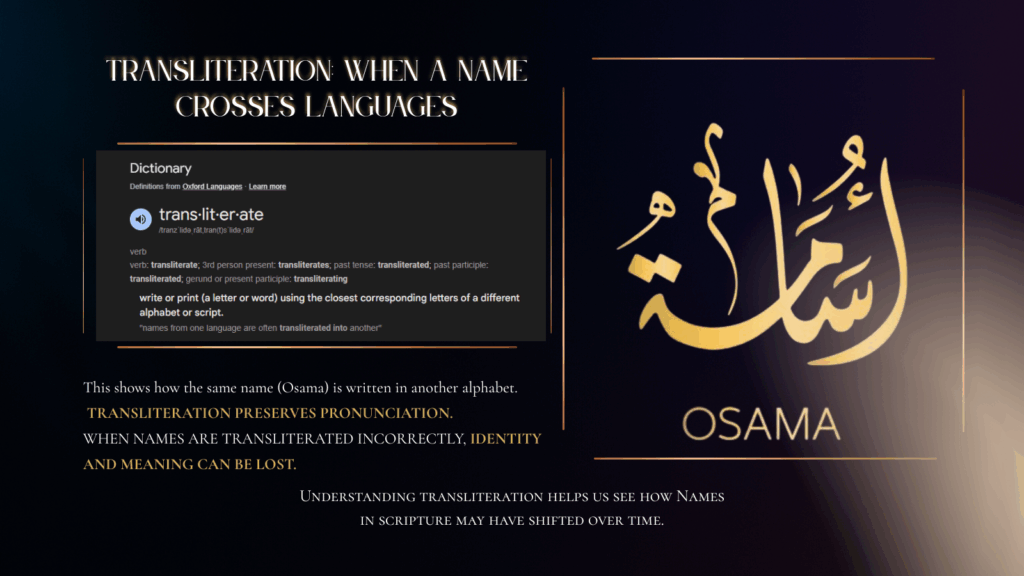
Transliteration preserves identity.
Transliteration carries the sound — not the spelling — so a name can cross languages without losing its identity.
The moment translators chose meaning over memory, something sacred was lost.
A translation tells you what a word means — a transliteration tells you who that word is.
When YHWH became LORD, the world was given a title instead of a Name, and a personal Elohim was reduced to a position.
Titles can be shared; Names cannot.
When Yahuah’s Name was replaced, His identity was blurred across cultures and centuries.
And if the enemy can confuse identity, he can confuse allegiance. Because you cannot call upon what you do not know — and you cannot truly know someone whose Name you’ve forgotten.
We were not commanded to call Him by whatever feels comfortable. We were commanded to call upon His Name.
Exodus 3:15 says it clearly:
“This is My Name forever,and this is My remembrance to all generations.”
His Name was never meant to be debated — it was meant to be remembered.
Where We Still See His Name Preserved
Even with the translator’s edits, Abba made sure His Name couldn’t be completely erased.
Psalm 68:4 reminds us plainly:
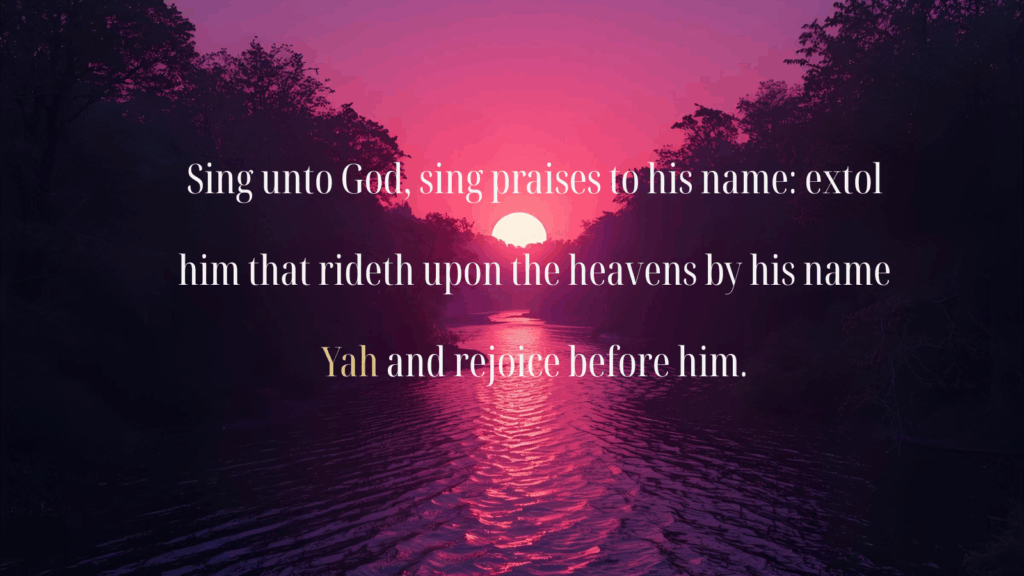
“Sing to Elohim… by His Name Yah.”
Every time we say Hallelu-Yah, we’re already proclaiming it — “Praise be to Yah.”
His Name was never lost; it was hidden in plain speech, waiting to be uncovered by those willing to look closer.
And yet, He’s not only Elohim — He’s Abba.
That word doesn’t replace His Name; it reveals His heart.
It’s what Yahusha Himself said in Mark 14:36, and what Paul echoed in Romans 8:15 and Galatians 4:6.
When we cry out Abba, we speak as children to a Father — not out of formality, but intimacy.
He carries many titles — Healer, Provider, King — but only one Name that seals the covenant.
The Substitution of “Lord”
Reason 2 — Covenant: How the Gray Was Born
Yahuah didn’t just free Yashara’al from Egypt — He formed them in the wilderness.
He gave them laws, festivals, and patterns of holiness — a rhythm of remembrance.
They weren’t just rescued; they were reborn as a set-apart nation.
But what happens when a people who are called to lead start looking around instead of looking up?
They entered the land He promised, but that land came with a warning:
Exodus 23:32–33 — “You shall make no covenant with them or their mighty ones. They shall not dwell in your land, lest they make you sin against Me; for if you serve their mighty ones, it will surely be a snare to you.”

Yet curiosity crept in like smoke through cracked walls.
Instead of tearing down the altars, they studied them.
Instead of burning down the pillars, they decorated them.
And by the time of the Judges, the people chosen to lead the nations had started learning from them instead.
Psalm 106:34–39 says, “They mixed with the nations and learned their works.”
That word mixed is everything gray stands for — compromise clothed as coexistence.
Deuteronomy 7:2,5 gave the command plainly:
“Smite them, show them no favor… break down their altars, smash their pillars, cut down their Asherah poles, and burn their carved images with fire.”
But they didn’t.
And what Yahuah had warned became the law of cause and effect:
What you don’t destroy will eventually disciple you.
Imagine being part of a people who had literally seen the Red Sea split — and yet, within a generation, forgot the Name that parted it.
Judges 2:7 says the elders who witnessed His works served Yahuah faithfully.
But Judges 2:10 records the unraveling:
“There arose another generation after them who did not know Yahuah, nor the works which He had done for Yashara’al.”
They didn’t forget because the stories weren’t told — they forgot because they stopped doing what the stories were about.
Their mouths remembered the words, but their lives stopped reflecting the obedience those words required.
In Hebrew thought, to remember isn’t nostalgia — it’s action.
To remember Yahuah is to obey Him.
When obedience fades, remembrance becomes folklore.
So Yahuah sent a messenger to remind them of what He had said from the beginning:
Judges 2:1–3 — “I led you up from Egypt and said, ‘I will never break My covenant with you.’ But you have not obeyed My voice… therefore I also said, ‘I will not drive them out before you; they shall be thorns in your sides, and their mighty ones shall be a snare to you.’”
They disobeyed His voice, and the nations they envied became their teachers.
They traded covenant for curiosity — obedience for observation.
And Yahuah said, in essence, “Fine. Let’s see what you learn without Me.”
Judges 2:22 — “Through them I may prove Yashara’al, whether they will keep the way of Yahuah, to walk therein as their fathers did, or not.”
This wasn’t abandonment — it was exposure.
The test wasn’t to destroy them; it was to reveal them.
And that’s why the Feast Days foretold in the bible matter.
They are more than celebrations — they’re rehearsals of remembrance.
Each moedim (appointed time) retells the story of redemption, covenant, and promise.
They keep us from forgetting the One who brought us out.
When we honor Yahuah’s appointed times, we realign with the rhythm He gave His people in the wilderness —
the rhythm that keeps us from wandering into the gray.

But comfort has always been the gatekeeper of captivity.”
Why Yahuah’s True Name Still Matters
Reason 3 — Obedience: Returning to the Narrow Way
What altars have we left standing?
We may not bow to carved Asherah poles, but we still bow to schedules, systems, and cultural idols that pull us from obedience.
Every time we celebrate what Yahuah called wicked, or justify what He called unclean, we repeat their story — just dressed in modern decor.
The truth is, Yahuah never withdrew His covenant. We did.
And the same test remains: Will His people walk the narrow way, or keep blending into the wide one?
He told them to drive out what opposed Him — not because He hated those people,
but because He loved His own too much to watch them dissolve.
What Yashara’al Was Always Meant to Be
Yahuah never called a religion — He called a people.
Not denominations or doctrines, but a family.
A nation. A priesthood of light.
From the beginning, Yashara’al was meant to reveal Him, not just represent Him.
Their covenant was a reflection of His character — justice, mercy, obedience, and love in motion.
Deuteronomy 4:5–8
“You are a set-apart people to Yahuah your Elohim… Yahuah chose you not because you were many, but because He loved you and keeps His oath.”
Isaiah 49:6 —
“I will also give you as a light to the nations, that you should be My deliverance to the ends of the earth.”
That was always the plan:
That Yahuah’s laws, shining through His people, would cause other nations to say,
“Teach us your ways.”
But when Yashara’al mixed light with darkness, they blurred the message.
The world saw confusion where there was meant to be clarity.
Isaiah 5:20 —
“Woe to those who call evil good, and good evil;
who put darkness for light and light for darkness.”
Ezekiel 22:26 —
“Her priests have done violence to My law… they have hidden their eyes from My Sabbaths,
so I am profaned among them.”
We Were Always the Inheritance

Yahuah’s covenant with Abraham wasn’t a one-time promise — it was a blueprint for belonging.
He told Abraham that through his seed,
“All nations shall be blessed.” (Genesis 22:18)
That means the goal was never separation for superiority —
it was separation for sanctification,
so that through His people, the world could find Him again.
Zechariah 8:23 —
“In those days ten men from every language of the nations
shall grasp the sleeve of a man who is a Yahudi, saying,
‘Let us go with you, for we have heard that Elohim is with you.’”
That’s the image: nations clinging to those who walk in truth.
We weren’t called to judge from a distance — but to shine from within.
So the question becomes:
Are we living in a way that would make anyone grab hold of us and say,
‘Take me where you’re going’?
“Set apart doesn’t mean ‘better than.’ It means ‘trusted with.’”
— Salt & Light Study Participant
We were chosen to reflect His light, not replace His Name.
To preserve His ways, not edit them for comfort.
And that’s why this generation must reclaim the role Yashara’al forgot —
to be the mirror of obedience in a world obsessed with options.
Prophecy: The Renewed Name
Reason 4 — Prophecy: The Renewed Name
Scripture tells us that in the last days, Yahuah’s Name will be renewed and restored to His people. What we are seeing right now is not random curiosity—it is fulfilling prophecy. The prophets declared that His people would once again call on His Name in truth, and today that is exactly what is happening.
Zephaniah 3:9 reminds us: “For then I will restore to the peoples a pure language, that they all may call on the Name of Yahuah to serve Him with one accord.” This pure language isn’t about a trendy phrase—it’s about covenant renewal. It’s about the renewed Name that brings His people out of compromise and into alignment with His will.
Every time we confess His Name, we are walking in prophecy. Jeremiah 16:21 says, “Therefore, behold, I will this once cause them to know, I will cause them to know My hand and My might; and they shall know that My Name is Yahuah.” This is being fulfilled right now as more and more people uncover and declare the true Name of Yahuah.
The return to His Name is more than a movement—it is fulfilling prophecy. It proves that Yahuah’s Name matters today because it is the signpost of a people being restored to Him.
The Messy Middle & the Narrow Path
Let’s be honest — many of us are living in what I call the messy middle.
We love Yahuah, but we still flirt with Egypt.
We raise our hands in worship but still scroll the altars of Babylon.
We crave His peace, but keep making peace with the very things He called us to destroy.
Sound harsh? Maybe.
But gray isn’t neutral — it’s deception.
Matthew 7:13–14 —
“Enter through the narrow gate.
For wide is the gate and broad is the way that leads to destruction, and many enter through it.
But small is the gate and narrow the road that leads to life, and only a few find it.”
Narrow paths don’t attract crowds.
They attract covenant-keepers.
In the messy middle, we confuse comfort for confirmation.
We say, “Yahuah knows my heart,” but do we ask if He knows our obedience?
Matthew 7:21–23 exposes the gray perfectly:
“Not everyone who says to Me, ‘Master, Master,’ will enter the reign of the heavens,
but only the one doing the desire of My Father…
And then I will declare to them, ‘I never knew you; depart from Me, you who work lawlessness.’”
That word lawlessness in Hebrew thought isn’t rebellion by accident —
it’s the choice to live without His commands.
So the real question isn’t, Do I believe?
It’s, Do I obey?
“Obedience is better than sacrifice.
But today, obedience is the sacrifice.”
When we ignore His laws, the enemy doesn’t need to persecute us —
he just partners with our comfort.
Proverbs 14:12 —
“There is a way that seems right to a man, but its end is the way to death.”
Romans 12:2 —
“Do not be conformed to this world, but be transformed by the renewing of your mind,
that you may discern what is good, acceptable, and perfect.”
This is the daily call:
To renew.
To discern.
To separate.
To refuse the middle — and choose the narrow.
Isaiah 40:8 — “The grass withers, the flower fades, but the Word of our Alahym stands forever.”
At the heart of it all, this is why we can no longer stay in the gray. Yahuah’s Name matters today — not as a distant relic, but as a living truth that shapes our covenant walk. We’ve seen the power of His Name, the dangers of substitutions, and the reasons why His Name still matters. And now, prophecy itself is being fulfilled as His people embrace the renewed Name and take their place on the ancient path.
The prophets declared it, and we are living it: the awakening to the true Name of Yahuah is not an accident — it is fulfilling prophecy. Every time we return to His Name, we are stepping out of compromise and into covenant.
So, whether you are just beginning to question or you have already set your feet on the narrow path, let these 4 powerful reasons remind you: restoring His Name is the key to walking in truth. And in these last days, there is no greater confession than declaring that Yahuah’s Name still matters today.
Coming Out of the Gray
Maybe this is the moment we stop excusing disobedience as “grace.”
Maybe it’s time we remember that grace was never meant to replace the law —
it was meant to empower us to live it.
Yahuah’s standard never changed, because His covenant never failed.
He told us what to do.
We wrote books about why we don’t have to.
So here’s the question:
Will we keep calling Him “Lord” while living like Baal’s followers?
Or will we reclaim His Name, His truth, and His way —
even if it means standing alone?
When we start walking that narrow road again, something shifts.
Our homes align.
Our words carry weight.
Our hearts rest.
And our lives become living proof
that gray can’t exist where light is full.
Next week, we will continue our journey out of the gray as we unpack Deuteronomy 28 — Who Are We?
It’s not just a history lesson; it’s prophecy fulfilled.
We’ll trace the blessings, the curses, and the confusion of faces that scattered Yashara’al — and see how restoration is already unfolding among those returning to the ancient path.
Stay tuned and stay set apart. The journey out of the gray continues.
There’s a moment in every journey where the light hits just right — and we see what’s been hiding in plain sight.
That’s what Out of the Gray was for me: a reminder that the Yahuah never changed His covenant — we did.
And yet, His mercy keeps calling us back.
If this stirred you, sit with it.
Ask Abba to show you the altars you’ve tolerated, the truths you’ve replaced, and the Names you’ve forgotten.
Because this isn’t just about returning to Hebrew — it’s about returning to Him.

“Everyone who calls on the Name of Yahuah shall be delivered.” — Joel 2:32
May this be the season we call, we obey, and we remember.
🕊 Salt & Light: The Awakening Series — Part 1 of 3
✨ Continue the Journey ✨
The story continues in
Faces Confused —
where we explore seven prophecies that foretold Israel’s scattering and lost identity.
Selah — pause and let the Name speak.
STAY SALTY. BE LIT.
Join the conversation → Salt & Light Collective Bible Study every Sunday at 7 PM ET.
Catch up on past reflections, share your insights below, and look ahead to our next deep dive: “Faces Confused.”
Then keep walking with us during the week on our podcast,
Salt & Light Confessions — stories, scripture, and set-apart living for today.
Start with the trailer and walk with us as new confessions unfold.
A modern voice on the ancient way.
— Tai ~ Baht-Yah, Daughter of Yah
Comments
BE THE FIRST TO WRITE A COMMENT